
Building a multi-tenant SaaS product means thinking carefully about how data gets stored, managed, and accessed across customers. For many products, a Master Data Management (MDM) module is a key piece of that puzzle — it's what governs the shared, core data that defines the business entities inside your application. This article looks at how to design and build MDM modules for a multi-tenant environment, covering timing, best practices, and the mistakes teams commonly make along the way.
What Does Master Data Management Mean in a Multi-Tenant Setup?
In a multi-tenant SaaS application, every customer — every tenant — operates in its own isolated space. Transactional data, like invoices or user activity, is always strictly separated by tenant. Master data, on the other hand, is often shared across tenants. Think of things like a product catalog, a country list, or standardized industry codes. In this context, an MDM module is the system responsible for centrally managing that shared data, while still letting each tenant access — and sometimes extend — it without affecting anyone else.
The central challenge is striking a balance between isolation and sharing. You don't want to duplicate master data for every tenant, since that's inefficient and a maintenance headache. But you also need airtight guarantees that changes one tenant makes never spill over into another tenant's data.
When to Build Your MDM Module
The right time to build a proper MDM module usually isn't at day one — it's once you actually understand your core business logic and what your tenants need.
1. Early stage (pre-launch/MVP): In these early days, hold off on building a fully-featured MDM system. Prioritize shipping a minimum viable product instead. A basic hard-coded dataset, or even a single shared table across all tenants, is usually enough to validate the product early on. What matters most here is choosing a schema that's forward-compatible, so it can be refactored later without major pain.
2. Mid stage (post-MVP, pre-scale): This is typically the right window to invest in a dedicated MDM module. Once you have a handful of tenants and are starting to onboard more, the cracks in your original ad-hoc setup will start to show. Requests for tenant-specific data changes will start coming in — ones your current system likely can't support. By this point, you'll have enough real usage data to make informed calls about what data should stay universally shared and what needs to be customizable per tenant.
3. Late stage (growth/scaling): If you haven't built a real MDM module by this point, it becomes urgent. Manually working around master data management for dozens or hundreds of tenants turns into a serious bottleneck for engineering, sales, and support alike. At this stage, the MDM module needs to be treated as a foundational initiative with real resourcing behind it.
Mistakes Engineering Teams Commonly Make
Designing for multi-tenancy is genuinely difficult, and teams tend to fall into a handful of recurring traps around MDM.
Mistake #1: Treating it as all-or-nothing. Teams often build with a rigid mindset — data is either fully shared across every tenant, or fully isolated, with nothing in between. In reality, a well-designed MDM module supports a hybrid model. A global product catalog might be shared by default, while individual tenants can still add their own custom products or adjust certain attributes, like pricing, to fit their needs.
Mistake #2: Overlooking tenant customization. One of the most frequent mistakes is assuming master data is static and identical for every tenant. That assumption leads to a rigid system that can't flex to a tenant's specific business needs — for example, a tenant wanting to add a custom field to track an internal product category, or wanting to rename a standard "region" to something that fits their business. A good MDM design needs to accommodate that kind of flexibility from the start.
Mistake #3: Overengineering data isolation. Data security matters, but some teams take isolation too far — for instance, spinning up a separate database per tenant for everything, master data included. That approach is costly and hard to maintain at scale. A more sustainable pattern is a single shared database for master data, with a tenant identifier built into the schema. It's both cheaper and far easier to manage as you grow.
Mistake #4: Skipping data governance. Master data has to stay clean, consistent, and accurate. Without a real MDM system in place, your core business data can quickly get corrupted by inconsistent manual entries. A proper MDM module should include validation, de-duplication, and a clear, controlled process for making changes. Skip this, and you end up with "garbage in, garbage out" spreading through the entire application.
How to Design an Effective MDM Module
A solid MDM module generally rests on a few core design principles:
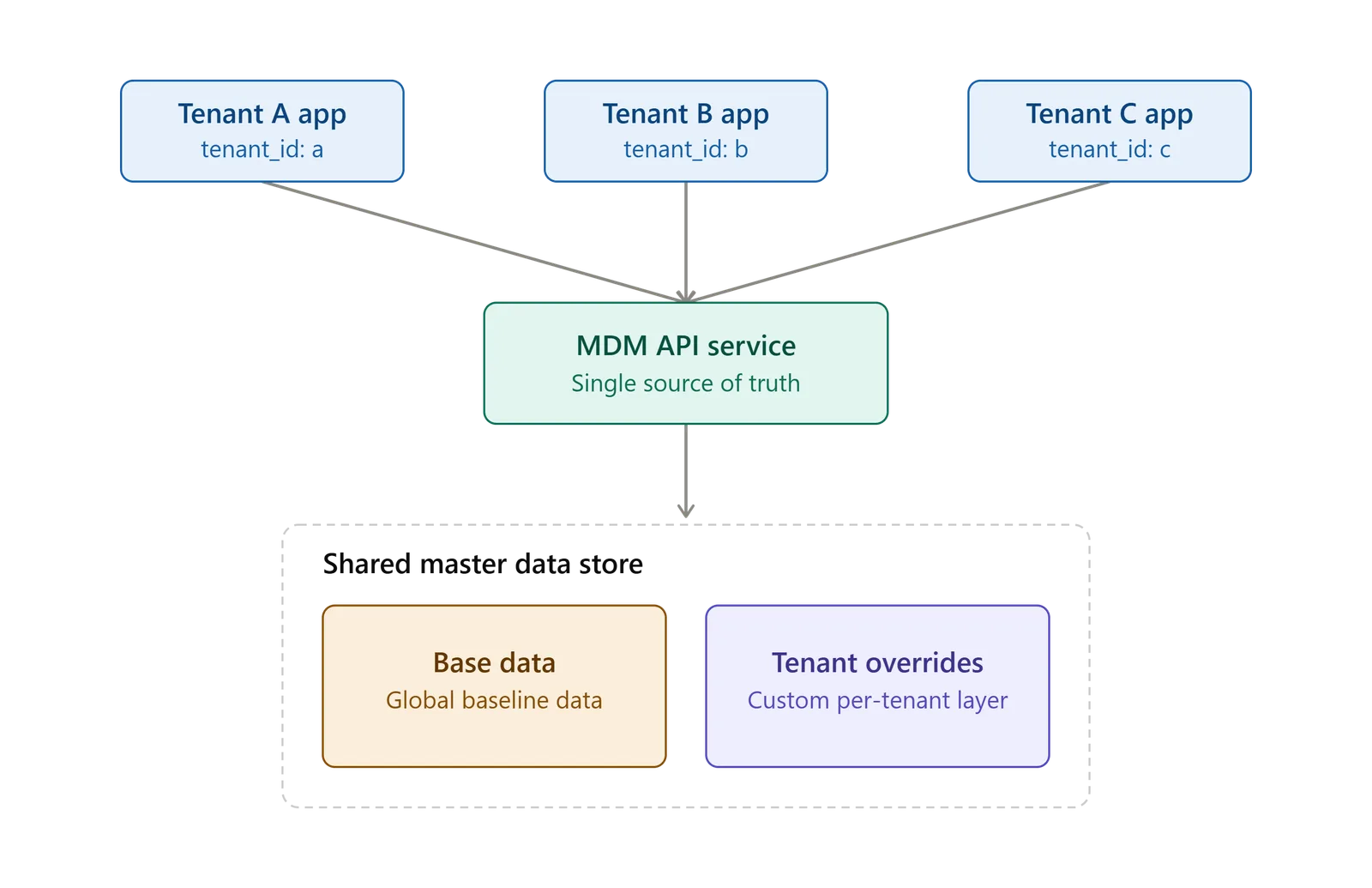
Shared schema, tenant-aware by design: The most scalable pattern is a single database schema for master data, with a tenant_id column on every relevant table. This makes it straightforward to query and filter data per tenant. Keep one single source of truth for all master data, and use the tenant_id field to enforce access control and isolation at the application layer.
Base data with tenant-level overrides: Your module should support both standardized base data and tenant-specific overrides. Base data is the shared, global baseline — for example, the official name of a country. Individual tenants can then layer their own local versions or overrides on top of specific attributes. A tenant might, for instance, rename "United States of America" to "USA" for internal use. The system should always check for a tenant-specific override first, and only fall back to the base data if none exists.
Build it as a layered service: Your MDM module should function as its own service with a dedicated API, decoupled from the rest of your application. This makes it far easier to maintain and evolve over time. All interactions with master data should go through that API, ensuring every change follows a controlled, predictable process. This service-oriented structure also simplifies onboarding new tenants down the line.
Getting these design decisions right — and steering clear of the common pitfalls — is what allows engineering teams to build an MDM module that's genuinely robust and scalable, one that can flex to support the unique needs of every tenant on a multi-tenant SaaS platform.